
How to Write Captions for Ads That Actually Drive Clicks and Conversions
Most ad captions underperform for a specific reason: they were written like organic posts. Community-building tone, soft CTAs, hashtag stacks — all of it works fine when you are posting to an audience that already follows you. In paid placements, it costs you money.
When someone scrolls past your ad, you have paid for that impression and gotten nothing in return. A caption that does not stop the scroll, surface a clear benefit, and tell the reader exactly what to do next is not just forgettable — it is expensive.
This article gives you a practical system for writing ad captions as direct-response copy: the formulas that work, the platform rules that determine what gets seen, and the funnel-stage alignment that most advertisers skip entirely. No organic-social filler. No template-copying without understanding why.
Key Takeaways
- Ad captions are direct-response copy. They exist to drive a specific action, not build community or earn likes.
- Your caption's first line is the only line guaranteed to be seen — write your hook within the first 125 characters on Meta Feed placements.
- PAS, AIDA, and hook-story-CTA are the three frameworks that cover most paid ad scenarios — each one has a different job depending on your objective and audience.
- Platform truncation is a conversion risk, not a formatting detail. Know where each platform cuts off before you write a single word.
- Awareness, retargeting, and conversion captions require different tone, length, and CTA intensity — writing one caption for every objective is one of the most common budget-wasting mistakes.
- Specificity converts. "Lose 8 pounds in 30 days or we refund you" outperforms "Start your fitness journey today" every single time.
Ad Captions vs. Organic Captions: Why the Distinction Matters
Organic captions work by building familiarity over time. The reader follows you, expects your content, and rewards authenticity. The caption can breathe — it can tell a story, invite conversation, use hashtags to extend reach, and close softly because the relationship already exists.
Paid ad captions operate under completely different conditions. The reader did not ask to see your ad. You interrupted their scroll. You have roughly two seconds to give them a reason to stop, and the caption has to earn that attention in a paid placement against dozens of other advertisers competing for the same eyeball.
That changes everything about structure. The organic caption can build to a point. The ad caption has to lead with one. The organic post can end with "What do you think?" The ad caption needs to end with a specific action. In paid placements, a soft CTA is not humble — it is a conversion failure.
Caption truncation compounds the problem. Meta Feed ads cut off primary text after roughly 125 characters before showing a "more" prompt. If your offer, your benefit, or your hook lives after that cutoff, most readers will never see it. You are paying for impressions where your best line goes unread.
The visual and the caption are also a team in paid ads in a way they rarely are organically. The creative gets the stop. The caption does the selling. If your caption is just describing what is in the image, you are wasting the persuasive real estate that turns a view into a click.
Here is the difference made concrete:
Same product. Two different caption approaches.
Organic version: "We are so excited to share our new recovery drink with you ✨ Packed with electrolytes, zero sugar, and three amazing flavors. Tag a friend who needs this! #hydration #wellness #fitness"
Paid ad version: "Still sore two days after your workout? This recovery drink clears muscle fatigue in 24 hours — no sugar crash, no chalky taste. Try a 6-pack for free."
The organic version rewards followers who already trust the brand. The ad version does not assume trust — it earns attention by naming a real problem, delivering a specific claim, and offering a low-friction next step.
| Element | Organic Caption | Paid Ad Caption |
|---|---|---|
| Primary goal | Build community, earn engagement | Drive a specific action (click, purchase, lead) |
| Audience relationship | Existing followers with some brand familiarity | Strangers — or near-strangers — in an interrupted scroll |
| Tone | Conversational, warm, narrative | Direct, benefit-focused, persuasive |
| Structure | Flexible — can build to a CTA | Front-loaded — hook must appear before truncation |
| CTA strength | Soft or optional ("What do you think?") | Explicit and action-specific ("Start your free trial") |
| Hashtags | Essential for discovery and reach | Generally unused — they dilute the conversion message |
This distinction is not semantic. Conflating the two is the specific error that produces expensive underperformance. Name it, fix it, move on.
The Anatomy of a High-Performing Ad Caption
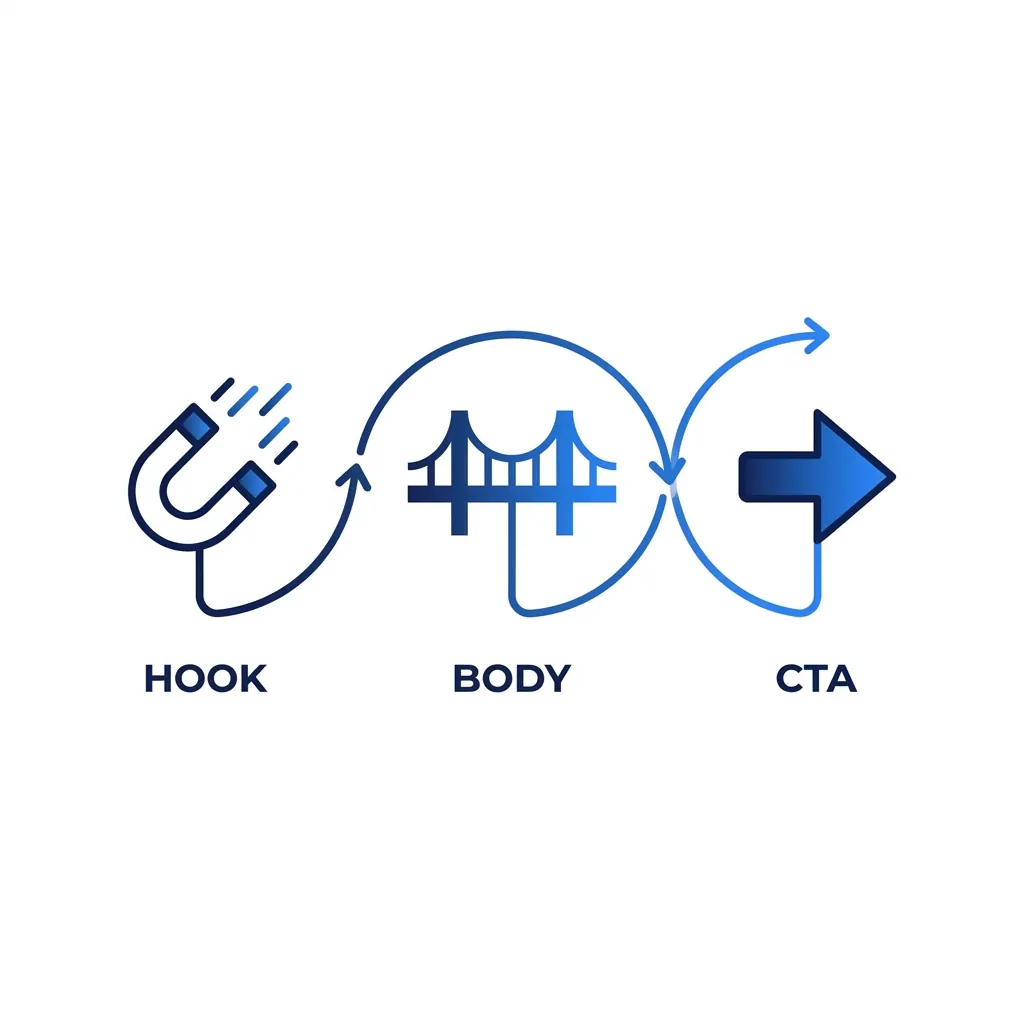
Every effective ad caption has three components: a hook, a body, and a CTA. They are not three separate sections — the reader should feel a single pull from first word to last. But understanding what each component must accomplish lets you diagnose exactly where a weak caption breaks down.
The Hook: The Only Line That Earns the Rest
If the hook does not stop the scroll, nothing else matters. The body and CTA are invisible to anyone who kept scrolling. The hook is the highest-leverage word in your caption, and it is the component most often written last and least carefully.
There are four hook types that reliably stop paid-ad scrolls:
| Hook Type | When to Use It | Example Opening |
|---|---|---|
| Question | When the reader's problem is specific and recognizable — they will see themselves in it | "Still paying full price for flights you booked weeks out?" |
| Pain statement | When the problem is felt but unspoken — naming it creates an immediate resonance | "Most freelancers lose 30% of billable hours to invoicing admin." |
| Bold claim | When you have a specific, credible result to lead with — not hype, but a verifiable outcome | "Our clients cut onboarding time in half within the first week." |
| Curiosity gap | When the audience is warm enough to lean in — creates tension that the body resolves | "There's one line in your checkout flow that's costing you conversions." |
Pick the hook type that matches what your audience most needs to feel in the first two seconds: recognized, understood, intrigued, or proven-to.
The Body: Bridge the Hook to the Offer
The body's job is narrow: take the hook's momentum and direct it toward the solution. It should answer the implicit question the hook raised, introduce the product or service as the resolution, and give the reader just enough specificity to create desire without burying them in detail.
Do not use the body to list features. "12 integrations, mobile app, 99.9% uptime" answers a question nobody asked in an ad. Translate every feature to a benefit, and make the benefit specific: "Connects to the tools you already use, works from your phone, and has never gone down during a campaign launch."
The CTA: Tell Them Exactly What to Do Next
"Learn More" is a placeholder. It tells the reader nothing about what they are clicking toward or why they should do it now. A strong CTA names the exact next step and frames it in the reader's interest, not yours.
- Product ad: "Get your first box for $5 — ships tomorrow."
- Service ad: "Book a 15-minute call and we will audit your current funnel free."
- Lead generation: "Download the free template — no email required."
The CTA should match the campaign objective precisely. A conversion-focused campaign with a soft CTA is a structural mismatch that loses money at every impression.
An annotated example:
"Sending 50+ emails a week and still missing follow-ups? [HOOK — pain statement naming a specific volume and a specific failure] Most CRM tools require hours of setup before they save you a minute. Ours connects to Gmail in 90 seconds and starts tracking replies automatically. [BODY — addresses the implicit objection, delivers a specific benefit with proof built in] Try it free for 14 days — no credit card." [CTA — explicit, low-friction, time-bounded]
Three components. One continuous pull. Notice what is absent: the brand name is not in the first line, there are no hashtags, and no line is wasted on context the reader did not need.
Caption Copywriting Formulas with Worked Examples
Frameworks fail when the writer copies the structure without understanding what each component is doing. The three formulas below work because they map to how humans process persuasion — they are not arbitrary templates. Use them with that in mind.
PAS: Problem-Agitate-Solution
PAS is the default formula for cold-audience ads where the reader does not know your product yet. It works by meeting the reader in their pain before offering anything.
- Problem: Name the specific problem the audience has — not vaguely, but precisely.
- Agitate: Make the cost of the problem felt. What does it mean to live with this problem another week, month, quarter?
- Solution: Introduce the product as the resolution — specific, credible, and tied directly to the pain you just agitated.
PAS in action — fitness supplement product ad:
Problem: "Muscle soreness hitting you two or three days after every workout?" Agitate: "That recovery lag is not just uncomfortable — it is cutting your training frequency in half and stalling your results." Solution: "RecoverX delivers electrolytes and BCAAs in the exact ratio your muscles need post-workout. Most users report next-day readiness within two weeks. Try a 7-day pack for $9."
Every line has a job. The problem creates recognition. The agitate creates urgency without manufactured scarcity. The solution answers both with specificity.
AIDA: Attention-Interest-Desire-Action
AIDA is better suited to service ads and longer consideration cycles where the reader needs to understand the product before they want it. The desire component is where AIDA earns its advantage over PAS — it gives you a dedicated step to build want before asking for action.
- Attention: The hook — interrupt the scroll.
- Interest: Give them a reason to keep reading — a surprising fact, a specific claim, a mechanism they have not heard before.
- Desire: Make the outcome vivid and personally relevant. This is where features become benefits become emotions.
- Action: Specific CTA matched to the objective.
AIDA in action — SaaS service ad:
Attention: "Your marketing team is publishing content on six platforms and tracking performance in four different dashboards." Interest: "Most teams spend 6+ hours a week just consolidating data that should already be in one place." Desire: "Imagine starting every Monday with a single report that shows what worked, what to cut, and where to push budget — pulled automatically overnight." Action: "See it live in a 10-minute demo. No deck, no pitch, just the product."
Hook-Story-CTA: The Retargeting Formula
For warm audiences who have already seen your brand, PAS and AIDA can feel redundant — they already know the problem. Hook-story-CTA works by acknowledging prior exposure, adding a human or social proof layer, and closing with a direct, specific ask.
Hook-story-CTA in action — retargeting ad for a consumer subscription:
Hook: "You checked us out a few weeks ago. Here is what happened since then." Story: "Over 4,000 people started their first month with us in October. Most said the same thing: they wished they had not waited. The setup takes 8 minutes. The results show up on your first project." CTA: "Your 30-day free trial is still open. Start today — no commitment, cancel anytime."
Before and After: Seeing the Transformation
The abstract principle becomes real when you see a weak caption rewritten using the formula. Here are two rewrites with annotations:
| Version | Caption | Annotation |
|---|---|---|
| Weak | "Introducing TrailGear Pro — premium hiking boots built for serious adventurers. Shop the new collection." | Opens with brand name, leads with a product label, CTA is generic. The reader has no reason to care. |
| Rewritten with PAS | "Your boots gave out on mile 6. That is not a gear problem — it is a design problem. TrailGear Pro is built with a reinforced midsole rated for 500+ miles of technical terrain. Ships in two days. Get yours." | Pain is specific and physical. Agitate reframes blame. Solution is credible (500+ miles) and low-friction (ships in two days). |
| Version | Caption | Annotation |
|---|---|---|
| Weak | "Our project management tool helps teams collaborate and stay organized. Try it free." | Feature-level description, no specificity, no desire. Every competitor could run this exact caption. |
| Rewritten with AIDA | "Your team is running three projects and using five apps to track them. (Attention) The average team loses 7 hours a week to status update meetings that a single dashboard would replace. (Interest) Imagine a Monday standup where every answer is already on the screen. (Desire) Try Taskline free for 21 days — setup takes less time than your next standup." (Action) | Each component does distinct work. Desire is concrete and imageable. CTA uses the product's own time-saving claim as its frame. |
For documented copywriting formula theory and background on PAS and AIDA, CopyHackers offers one of the most thorough published breakdowns of conversion copywriting frameworks available.
Platform-Specific Caption Rules: Length, Truncation, and Format
Knowing your formula is only half the equation. A perfectly constructed PAS caption is worthless if the solution line gets cut off by truncation before anyone reads it.
Every major ad platform has a point where the caption text disappears behind a "more" or "see more" prompt. Most advertisers either do not know where that cutoff is or write to an arbitrary word count that may or may not align with it. The result: your best line — the offer, the proof, the CTA — goes unseen by the majority of viewers who do not tap to expand.
Write your most critical message — the hook or the core offer — within the first visible characters, regardless of total caption length. Then work backward from there.
| Platform | Ad Type | Characters Before Truncation | Recommended Caption Length | Key Formatting Notes |
|---|---|---|---|---|
| Meta Feed | Feed (Facebook and Instagram) | ~125 characters | 125–300 characters for conversion; up to 500 for retargeting with story | Emojis render well; line breaks supported; avoid hashtags in paid captions — they dilute CTA focus |
| Meta Stories | Stories (Facebook and Instagram) | Text overlay dominates; caption field less prominent | 50–100 characters or minimal text — let overlay carry the message | Caption copy should complement overlay, not duplicate it; short declarative lines only |
| Meta Reels | Reels (Facebook and Instagram) | ~125 characters before truncation in feed context | 100–150 characters; lean short with strong hook | On-screen text handles storytelling; caption should be a standalone hook or CTA reinforcement |
| TikTok In-Feed | TikTok Ads In-Feed | ~100 characters visible before truncation | 100–150 characters; very short performs well here | Caption field is secondary to video hook; use it to reinforce the video's CTA or add the offer |
| Google Display | Responsive Display Ads | Headline: 30 characters; Description: 90 characters | Headline 25–30 characters; Description 70–90 characters | No single caption field — headlines and descriptions function as caption equivalents; every word earns its place |
For Meta placement specifications, Meta ad specs including copy length guidelines and character limits are published and updated by the platform. For TikTok, the official TikTok Ads creative and format documentation covers in-feed ad caption behavior and text overlay guidance.
The practical rule that holds across every platform: if a reader only sees the first line of your caption, does that line alone do enough work to earn a click? If the answer is no, rewrite the first line before adjusting anything else.
A note on hashtags in paid captions: They work in organic posts because they extend discovery reach. In paid ads, the platform handles targeting — hashtags do not add distribution, they just fragment the copy and drag the reader's eye away from your CTA. Leave them out.
A note on emoji: On Meta placements, emojis render correctly and can function as bullet points or visual breaks in a longer body. Use them purposefully — one or two to break up a list of benefits, or as a directional indicator pointing at the CTA. Do not use them decoratively at the expense of copy clarity.
Writing Captions by Campaign Objective
The same product needs three fundamentally different captions depending on where the audience is in their relationship with your brand. Writing one caption for every objective is one of the most common and most expensive ad mistakes — not because the creative is wrong, but because the message temperature is mismatched to the audience temperature.
Think of it this way: a cold audience needs to understand why the problem matters before they can care about your solution. A warm audience already gets it — they need a reason to act now. A hot retargeting audience has already shown intent — they need friction removed, not more explanation.
Here is how caption strategy shifts across the three stages, illustrated with the same product: a time-tracking app for freelancers.
Stage 1 — Awareness: Surface the problem, earn the click
Objective: Make the reader aware they have a problem worth solving. Avoid hard CTAs — the audience is not ready. A soft, curiosity-driven CTA works better than a "Buy now."
"Most freelancers undercharge by 15–20% — not because they set bad rates, but because they never tracked where the hours actually went. Curious what yours look like? See how it works."
What changed: Lead with the insight, not the product. CTA is "see how it works" — low commitment, high curiosity. No pricing, no trial offer.
Stage 2 — Retargeting: Acknowledge familiarity, add proof, push with urgency
Objective: Warm the reader who has already seen your brand. They know who you are — now give them the social proof or urgency that tips them from interested to committed.
"You looked at Clockwork last week. Here is what others said after their first month: 'I found three hours I was giving away for free every week.' Over 12,000 freelancers are now billing for every minute. Your 30-day free trial is still available — starts in two clicks."
What changed: Opens by acknowledging prior exposure. Social proof is specific (12,000 users, a direct quote). CTA is more direct and time-aware.
Stage 3 — Conversion: Lead with the offer, remove friction, close specifically
Objective: The audience knows the product and is close to deciding. Lead with the strongest benefit, make the CTA explicit and low-friction, and remove every possible reason to hesitate.
"Clockwork pays for itself the first week — most users find $200–$400 in unbilled hours in their first 30 days. Start your free trial now. No credit card. Cancel in one click if it does not deliver."
What changed: Leads with the financial outcome (specific, credible). CTA is direct and objection-preempting (no credit card, one-click cancel). No soft language — this audience is ready.
Caption length also reflects this progression. Awareness captions can be short — the goal is a spark, not a close. Retargeting captions can afford more words because the reader's familiarity supports a longer read. Conversion captions should be lean but complete — long enough to include the offer and remove objections, short enough not to give the reader time to reconsider.
Common Ad Caption Mistakes and How to Fix Them
Every mistake here is fixable with the frameworks above. The value of naming them explicitly is diagnostic: when a caption underperforms, you can identify which error type is driving the problem rather than rewriting from scratch and hoping for different results.
Opening with the brand name instead of a hook. "GreenShift is the leading sustainable packaging company for e-commerce brands" tells the reader about you. They did not ask. Lead with their problem instead: "Your packaging is arriving damaged — and your customer service inbox knows it."
Writing feature-first instead of benefit-first. "Our platform includes 50+ native integrations, a drag-and-drop dashboard, and real-time alerts" answers a question the reader has not asked yet. Translate: "See every campaign's performance in one dashboard — no tab-switching, no manual pulls, no Monday morning scramble."
Using a vague CTA when the objective demands specificity. "Learn More" tells the reader nothing about what happens next. Match the CTA to the exact next action: "Book your free 15-minute demo," "Start your trial — no card required," or "Download the 2024 benchmark report."
Ignoring truncation so the key message appears after the cutoff. If your hook is in the first line but your offer is in line four, and the platform cuts at 125 characters, you have paid for an impression that delivered a hook with no punchline. Front-load or restructure.
Writing the same caption for every placement, objective, and audience. The awareness audience and the retargeting audience are in completely different emotional positions. One needs to feel the problem. The other needs a reason to stop waiting. The same caption cannot serve both.
Before Your Next Ad Caption Goes Live, Run It Through This Check
- Does the first line work as a standalone hook — would it stop a scroll on its own?
- Is the most critical message (hook or offer) within the first visible characters for the target platform?
- Does the body connect the hook to a specific benefit or solution — not a feature list?
- Is the CTA explicit, action-specific, and matched to the campaign objective?
- Is the total caption length appropriate for the platform placement and ad type?
- Does the caption match the audience's funnel stage — cold (awareness), warm (retargeting), or hot (conversion)?
- Does the caption open with something other than the brand name?
If any of these checks fails, you have identified exactly what to fix before spending a dollar on distribution.
Start Executing the Framework at Scale
You now have the system: a framework for direct-response caption structure, three formulas with filled examples, platform-specific character limits, and a funnel-stage model that stops you from running the wrong message to the wrong audience.
The next constraint most advertisers hit is not knowing what to write — it is having the creative volume to test what they write. Multiple caption variations across three platforms and two audience segments adds up to a production problem fast.
That is where GotReach comes in. GotReach is built for teams that need to produce and distribute short-form video content across multiple platforms without the production bottleneck slowing down iteration. The same platforms covered in this article's caption specs — Meta, TikTok, and beyond — are handled in one workflow, from creation through publishing.
If you are ready to match your caption strategy with the content volume it needs to actually test and scale, explore GotReach's plans and start a 30-day free trial. No production agency required. No creative bottleneck between you and your next campaign.
Frequently Asked Questions
How long should a caption be for a Facebook or Instagram ad?
For Meta Feed ads, keep your hook and primary benefit within the first 125 characters — that is the visible text before the "more" truncation. Total caption length can extend to 300 characters for conversion-focused ads, or up to 500 for retargeting ads where a short story supports the close. The rule is not about length — it is about front-loading your most critical message.
What is the best caption formula for a product ad?
PAS (Problem-Agitate-Solution) performs consistently well for product ads targeting cold audiences, because it meets the reader in their pain before introducing the product. AIDA works better when the product requires more explanation or when desire needs to be built before the ask. Neither formula universally outperforms the other — the right choice depends on audience familiarity, product complexity, and campaign objective.
How do I write a caption that stops the scroll?
Lead with a hook that makes the reader feel immediately recognized or curious. The four hook types that work in paid ads: a question that names their specific problem, a pain statement they have not heard articulated before, a bold claim backed by a specific result, or a curiosity gap that creates tension the body resolves. The hook should stand alone — if it would not make someone pause, the body and CTA are invisible.
Should I use hashtags in paid ad captions?
No. In organic posts, hashtags extend discovery reach. In paid ads, the platform handles targeting — hashtags do not add distribution. They fragment the copy, pull the reader's attention away from the CTA, and signal organic content in a paid placement. Leave them out entirely.
How is writing a caption for an ad different from writing an organic post caption?
Organic captions build on an existing relationship — the reader already follows you and rewards authenticity and warmth. Ad captions interrupt a stranger's scroll in a paid placement where you have earned nothing yet. The structure has to front-load the persuasion, use a specific CTA, and treat every character as conversion real estate. The goal, structure, tone, and success metric are fundamentally different.
How do I write ad captions for different campaign objectives like awareness vs. conversions?
Awareness captions should surface the problem and use soft CTAs like "See how it works" — the audience is not ready to buy. Retargeting captions should acknowledge prior exposure, add social proof or urgency, and use a more direct CTA. Conversion captions should lead with the offer's strongest specific benefit and close with an explicit, low-friction action. Caption length generally increases from awareness to conversion as audience familiarity and purchase intent grow.
What should appear in the first line of an ad caption before it gets cut off?
Your hook — the single line that earns the rest of the caption. This should be a pain statement, a bold claim, a question, or a curiosity gap that makes the reader feel something before they decide whether to keep reading. It should not be your brand name, a product description, or a feature list. The first line is the only guaranteed impression your caption makes.