
How to Write Ad Captions That Actually Convert (With Platform-Specific Formulas and Examples)
Most caption advice online is written for organic social media posts. It teaches you to be relatable, use trending sounds, and end with a question to boost comments. That advice is not wrong for organic content. It is just the wrong job description for a paid ad caption.
Ad captions play by different rules. They land in front of people who did not follow you, did not ask to see your content, and are about to scroll past before they finish your second sentence. If the first line does not stop them, nothing else you wrote matters.
This article gives you a named framework (Hook-Body-CTA), platform-specific character limits, and annotated examples organized by ad objective. Everything here is written for paid advertising placements, not organic posts.
Key Takeaways
- Ad captions must earn attention from audiences who did not choose to see them. Organic caption logic does not transfer.
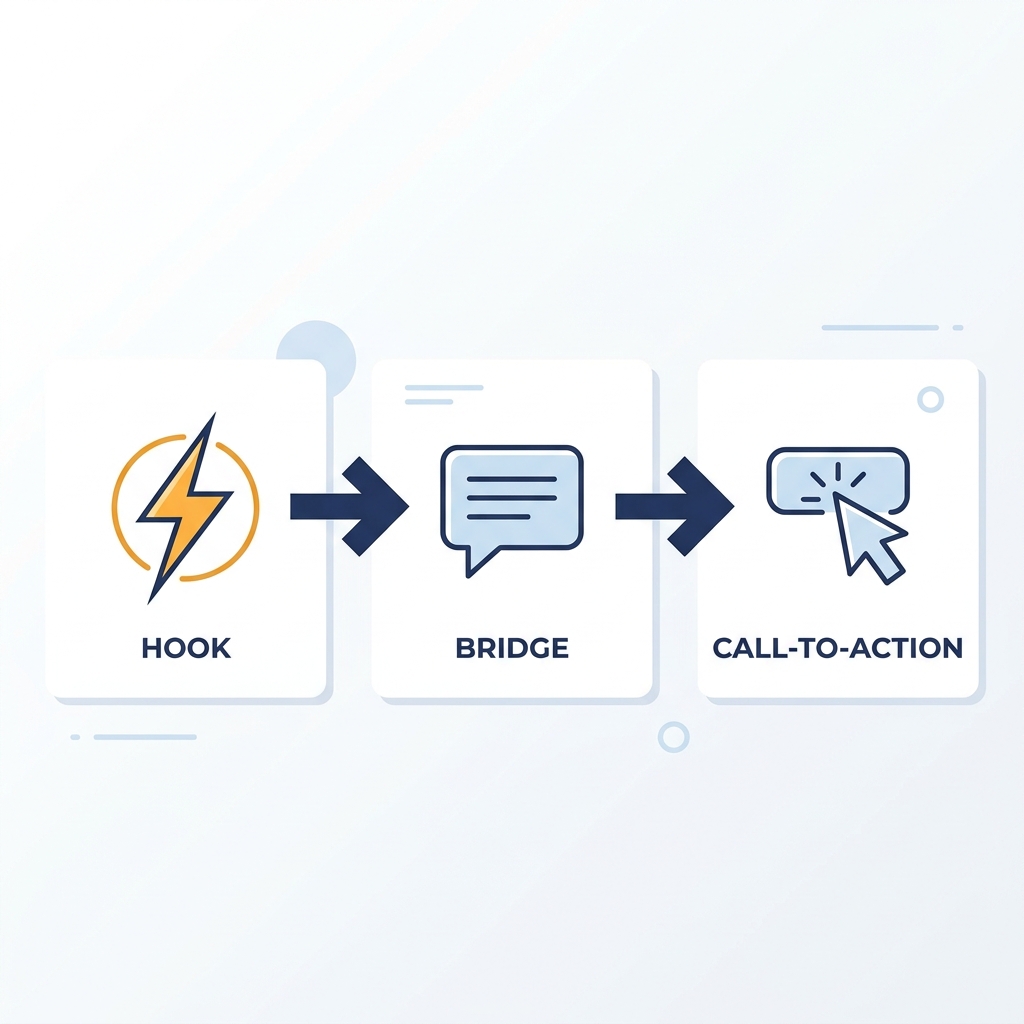
- Every high-performing ad caption has three components: a Hook that stops the scroll, a Body that connects the hook to the offer, and a CTA that tells the reader exactly what to do and what they get.
- Facebook and Instagram primary text truncates after approximately 125 characters. Your hook must land before that cut.
- The formula adapts to objective. An awareness caption resonates with a problem. A retargeting caption assumes prior exposure and drives action.
- Platform character limits are not a formatting detail. They determine whether your hook gets seen at all.
Ad Captions vs. Organic Captions: Why the Rules Are Different
Organic posts reach people who already chose to follow you. They opened the app, they scrolled to your content, and they have at least some prior relationship with your brand. Your caption can reward that existing interest.
A paid ad caption reaches a cold or warm audience that did not make that choice. The algorithm placed your ad in their feed. They have no reason to keep reading. Your caption has to earn their attention from zero.
That changes everything about how you write.
Organic captions can afford a slow build. Ad captions cannot. Organic captions can mirror brand personality without a hard payoff. Ad captions must connect to a specific campaign objective: awareness, consideration, or conversion. Organic posts rarely need to survive platform truncation because followers tend to expand them. Ad captions almost always get cut off before a cold audience reaches the CTA.
Applying organic caption logic to a paid ad placement is one of the most common reasons ad captions underperform. Here is what the two actually look like side by side:
| Characteristic | Organic Caption | Ad Caption |
|---|---|---|
| Audience relationship | Existing followers, warm | Cold or warm, opted-in by algorithm |
| Attention starting point | Earned through prior content | Must be earned in the first line |
| Primary goal | Engagement, brand affinity | Specific campaign objective (awareness, clicks, conversions) |
| Truncation pressure | Low (followers often expand) | High (cold audiences rarely tap See More) |
| CTA expectation | Optional, soft | Required, specific, and tied to campaign goal |
| Tone flexibility | High | Lower, constrained by ad policy and platform format |
| Platform compliance | Standard community guidelines | Additional ad policy rules on claims, language, and imagery |
The distinction matters before you write a single word. If you are not sure whether your content qualifies as an ad caption or something else, the difference between captions and subtitles is a useful place to start before diving into paid copy.
The Ad Caption Formula: Hook, Body, CTA
Every high-performing ad caption has three components. They are not suggestions. They are the structure. Missing any one of them is the most common reason a caption feels fine but fails to drive results.
Hook: The first line. Its only job is to stop the scroll before the reader processes the visual or hits the platform truncation point. A strong hook creates a pattern interrupt, poses a sharp question, or states a specific compelling outcome. It must work on its own, before any visual context.
Body: The middle. It connects the hook to the offer by addressing the audience's problem, amplifying desire, or introducing a proof point. Keep it audience-centric, not feature-centric. The body earns the right to the CTA.
CTA: The close. It tells the reader exactly what to do next and exactly what they get for doing it. A CTA that cannot answer both questions needs to be rewritten.
Here is how the formula looks in a real ad caption, with each component labeled:
[Hook] Still paying full price for skincare that stops working after week two?
[Body] Our serum delivers visible results in 14 days, backed by 4,800 verified reviews.
[CTA] Try it risk-free. Shop with our 30-day money-back guarantee.
The hook names a problem the audience recognizes. The body introduces specificity (14 days, 4,800 reviews) that builds credibility. The CTA answers both questions: what to do (shop) and what they get (risk-free trial with a guarantee).
The formula also adapts to ad objective. An awareness-stage hook names a problem the audience recognizes without assuming any prior brand knowledge. A retargeting hook assumes prior exposure and leads with urgency or social proof because the audience already knows who you are.
Short vs. Long Ad Captions: When to Use Each
Short Ad Captions (under 100 characters)
- Pro: Survives truncation on every platform. The full hook lands before the cut.
- Pro: Ideal for retargeting warm audiences who already have context.
- Pro: Forces clarity. Every word carries weight.
- Con: Limited room for proof, context, or objection handling.
- Con: Harder for cold audiences who do not yet recognize the brand or understand the offer.
Long Ad Captions (125+ characters)
- Pro: Room for storytelling, social proof, and objection handling.
- Pro: Better for cold audiences who need context before acting.
- Pro: Can move a reader through the full funnel in a single placement.
- Con: Most readers never reach the CTA if the hook does not earn continued reading.
- Con: Requires more craft to hold attention through the body before truncation cuts in.
Use short captions when your audience is warm, the offer is simple, or the platform punishes long copy (TikTok, Stories). Use longer captions when you are speaking to a cold audience, the product needs context, or you need to handle an objection before the CTA.
Ready to apply the formula? GotReach's AI caption generator gives you a starting point so you can focus on refining the structure rather than starting from a blank field.
Psychological Triggers That Make Ad Captions Perform
The Hook-Body-CTA formula is the structure. Psychological triggers are what make the structure connect with how people actually make decisions.
These are not tricks. They are the mechanisms behind effective copy. Understanding why each one works makes it easier to choose the right trigger and use it honestly.
Specificity over vagueness
Specific numbers, outcomes, and timeframes outperform broad claims because specificity signals credibility. Research on claim specificity and persuasive credibility supports what practitioners see in ad performance: vague language reads as marketing; specific language reads as fact.
- Weak: "Lose weight fast with our program."
- Strong: "Drop 12 lbs in 6 weeks, or your money back." (Trigger: specificity. The number makes the claim auditable. The guarantee removes risk.)
Urgency and scarcity
Time-limited or quantity-limited language drives action. But only when it is genuine. Manufactured urgency in paid placements damages trust with audiences that are already skeptical of ads. If the sale ends Sunday, say so. If it does not, do not pretend it does.
- Weak: "Limited time offer. Shop now."
- Strong: "Sale ends Friday. 40% off sitewide, no code needed." (Trigger: urgency with specificity. A deadline and a discount percentage both anchor the offer in reality.)
Social proof
Customer counts, testimonials, and usage references reduce perceived risk. They are especially effective in cold-audience captions where brand recognition is low. The audience has no relationship with you, so other people's experience substitutes for their own.
- Weak: "Thousands of customers love our product."
- Strong: "Over 62,000 subscribers started here. Join them." (Trigger: social proof with specificity. A real number outperforms a vague quantity claim.)
Curiosity gaps
Captions that hint at a benefit without fully revealing it drive click-throughs by creating an information gap the reader wants to close. The rule: the landing page must deliver on the implied promise. A curiosity gap that leads to a mismatched landing page kills conversions and damages brand trust.
- Weak: "You won't believe this skincare hack."
- Strong: "Most people skip this step in their skincare routine. It's the reason the rest of it isn't working." (Trigger: curiosity gap. The gap is specific enough to feel credible and broad enough to apply to a large audience.)
Platform-Specific Caption Requirements and Character Limits
Character limits are not a formatting detail. They determine whether your hook gets seen at all. Writing without knowing where the truncation point falls means writing captions that fail before they can be read.
The practical rule across every platform: assume truncation and front-load your hook and key message within the first 125 characters. If the most important part of your caption sits after the cut, a cold audience will never reach it.
Here is the current reference for major paid ad platforms, based on Facebook and Instagram ad character specifications and TikTok In-Feed Ad specs:
| Platform | Ad Format | Primary Text / Caption Limit | Truncation Point | Key Format Note |
|---|---|---|---|---|
| Feed | 125 characters recommended (up to 500+ supported) | ~125 characters, See More appears | Headline and primary text are separate fields. Hook must land in primary text before cut. | |
| Feed | 125 characters recommended (up to 2,200 supported) | ~125 characters, See More appears | Hashtags in paid placements add noise without SEO benefit. Use sparingly or skip entirely. | |
| Stories / Reels | Text overlay-dependent; caption field less prominent | Effectively no caption field in Stories | Copy lives in the visual overlay. Short, bold lines. No paragraph copy. | |
| TikTok | In-Feed Ads | 100 characters (ad caption field) | Full caption visible, but short copy performs better | Caption and on-screen text overlay are separate. Do not duplicate content across both. |
| Sponsored Content | 150 characters recommended (600 supported) | ~150 characters, Show More appears | Professional tone required. Avoid casual or colloquial phrasing. | |
| Google Display | Responsive Display Ad | Headline: 30 characters. Description: 90 characters | Full character limit is the truncation point | No single caption field. Headlines and descriptions are assembled by the platform. |
| YouTube | In-Stream / Bumper | Companion banner headline: 15 characters | Hard limit, no expansion | Caption field does not exist as a standalone element. Companion ad copy is the closest equivalent. |
A few things the table makes clear:
- Facebook and Instagram feed ads both truncate at approximately 125 characters even though they technically support much more. Write as if everything after 125 will not be seen.
- TikTok's caption field is limited to 100 characters, but TikTok also supports text overlays as a separate creative layer. These are not the same thing. Your caption and your overlay should add different information, not repeat each other.
- Google Display and YouTube do not have a traditional caption field. The copywriting discipline still applies, but the format is headlines and descriptions with hard character caps rather than free-form copy.
- LinkedIn's professional context changes what the hook can say. The same urgency-driven copy that works on Facebook will feel out of place in a LinkedIn Sponsored Content placement.
Managing caption variations across all these platforms manually adds up fast. GotReach's social media management workflow lets you handle publishing across platforms from a single system, so you are not copying and adjusting captions one placement at a time.
Ad Caption Examples by Objective: Awareness, Consideration, and Conversion
The Hook-Body-CTA formula stays the same at every funnel stage. What changes is how each element is used, because the audience's relationship to your brand changes at each stage.
Before you write, answer three questions:
- What is the audience's prior exposure to the brand? Cold audiences need context. Warm audiences need a reason to act now.
- What is the campaign objective? Awareness builds recognition. Consideration bridges interest and intent. Conversion drives the action.
- What is the one thing I want them to do next? Every caption should point to a single next step, not a menu of options.
Here are three captions for the same fictional direct-to-consumer brand (a natural sleep supplement), each written for a different funnel stage:
Awareness Caption (Cold Audience)
Still waking up at 3am even after 8 hours of sleep?
Most sleep problems are not about how long you sleep. They are about what interrupts your deep sleep cycle.
Learn why it happens (and what actually helps).
- [Hook]: Names a specific, recognizable problem. No brand mention. No product pitch.
- [Body]: Reframes the problem (not sleep length, but sleep quality) to create a new way of seeing the issue.
- [CTA]: Soft. Curiosity-driven. No purchase pressure at the awareness stage.
- Trigger active: Curiosity gap plus specificity (3am, 8 hours).
Consideration Caption (Warm Audience)
We're not another melatonin pill. Here's the difference.
Restora uses a clinician-formulated blend that supports your sleep cycle without next-morning grogginess. 4,200+ verified reviews. See how it works.
- [Hook]: Leads with a differentiator, not a product description. Assumes the audience has seen sleep supplements before.
- [Body]: Introduces specificity (clinician-formulated, no grogginess) and social proof (4,200+ reviews).
- [CTA]: Bridges intent without demanding a purchase. Invites comparison.
- Trigger active: Specificity plus social proof.
Retargeting Caption (Previously Engaged Audience)
You checked us out. Here's your reason to come back.
20% off your first order, this week only. No code needed.
Shop Restora now.
- [Hook]: Acknowledges prior exposure directly. This works with retargeting because the audience has already seen the brand.
- [Body]: Leads with the offer (20% off) and removes friction (no code needed).
- [CTA]: Direct, action-specific, no ambiguity.
- Trigger active: Urgency (this week only) plus specificity (20% off).
Notice how the same three-part structure produces three completely different captions because the audience context and objective shifted. Writing the same caption for every funnel stage is one of the most expensive mistakes in paid advertising.
Common Ad Caption Mistakes and How to Fix Them
Mistake 1: Leading with the brand name instead of a hook
The audience does not care who you are until you have given them a reason to. Opening with your brand name uses the most valuable real estate in the caption on something the cold audience has no emotional connection to.
- Before: "Restora is a natural sleep supplement designed to help you get the rest you deserve."
- After: "Waking up exhausted after a full night's sleep isn't normal. Here's why it keeps happening."
What changed: The brand name is gone from the first line. The hook earns attention by naming the audience's experience before introducing any product.
Mistake 2: Describing the ad visual instead of adding new information
The caption and the visual should work together, not repeat each other. If your ad image shows a product on a clean white background and your caption says "Introducing our new skincare serum," you have said nothing the image did not already say.
- Before: "Our new serum in a sleek, minimal bottle. Available now."
- After: "Most serums absorb in 60 seconds. Ours absorbs in 20. Skin feels different by day three."
What changed: The caption adds information the image cannot convey: speed, sensory outcome, and a specific timeframe.
Mistake 3: Vague or absent CTAs
"Learn more" with no payoff promise is not a CTA. It tells the reader what to do but not what they get for doing it. Both questions must be answered.
- Before: "Discover the Restora difference. Learn more."
- After: "See the full ingredient breakdown and what makes it different from every other sleep supplement. Read the breakdown here."
What changed: The CTA now specifies what the reader gets (ingredient breakdown, differentiation explanation) not just what they are supposed to do.
Mistake 4: Using the same caption across all platforms
A 300-character Facebook caption pasted into TikTok will exceed the 100-character field. A LinkedIn caption written with casual urgency will underperform in a professional feed context. Platform format and audience context both require adaptation.
Mistake 5: Burying the hook after the truncation point
If your most important sentence is the third one, a cold audience on Facebook or Instagram will never read it. Every caption should be written as if the first 125 characters are all the reader will see.
Ad Caption Self-Audit Checklist
Run this against every ad caption before it goes live. If any item fails, revise before publishing.
- Does the first line stop the scroll without relying on the visual to do the work?
- Is the key message front-loaded within the first 125 characters before platform truncation cuts in?
- Does the caption match the ad objective: awareness, consideration, or conversion/retargeting?
- Is the copy written around the audience's problem or desire, not the brand's features?
- Does the CTA answer both questions: what do I do next, and what do I get for doing it?
- Does the caption include at least one psychological trigger: specificity, curiosity, social proof, or urgency?
- Is the caption length appropriate for the platform and ad format?
- Does the caption add new information the ad visual does not already communicate?
- If this is a retargeting caption, does it assume prior context and lead with urgency or proof rather than an introduction?
Frequently Asked Questions
How long should a caption be for a Facebook or Instagram ad?
Facebook and Instagram feed ads both truncate primary text after approximately 125 characters, even though the field technically supports much more. Cold audiences rarely tap "See More," so treat 125 characters as your effective limit for the hook and core message. You can write more, but assume most people will not read past that cut.
What is the difference between a caption and ad copy?
In a paid ad context, the caption (or primary text) is the copy above or below the creative. Ad copy is a broader term that includes headlines, descriptions, CTAs, and any copy within the visual. In social ad placements, the caption is the free-form text field where the Hook-Body-CTA structure lives.
How do I write a hook for an ad caption that stops the scroll?
A strong hook does one of three things: names a specific problem the audience recognizes, poses a sharp question they want answered, or states a specific outcome they want to achieve. It must work before the reader sees the visual and before they hit the truncation point. If your first line could be the opening of an organic post, it is probably not sharp enough for a cold-audience ad.
Should I use hashtags in paid ad captions?
Generally no, for most paid placements. On Facebook and Instagram, hashtags in paid primary text add visual clutter without the organic discovery benefit they provide on unpaid posts. On TikTok, hashtags are more native to the feed format but still compete for the limited 100-character caption space. Use that space for your hook instead.
How do I write different captions for cold vs. warm audiences?
Cold audiences need context, credibility, and a reason to care. Your hook should name their problem, not your product. Warm audiences (retargeting) already know who you are, so skip the introduction and lead with urgency, a specific offer, or social proof that removes the remaining objection. The formula is the same; the inputs to each element change based on prior exposure.
Can I use the same caption across Meta, TikTok, and LinkedIn?
No. The character limits are different (125 characters effective on Meta, 100 on TikTok, 150 on LinkedIn), the audience context is different, and the tone expectations differ significantly between a consumer social feed and a professional one. Write a platform-specific version for each placement, starting from the same strategic framework but adapting length, tone, and CTA language to fit the format.
Put the Formula to Work
You now have a structure for every ad caption you will write: a hook that earns attention before truncation, a body that connects the hook to the offer, and a CTA that answers both the what and the why. You have the character limits for every major platform. You have annotated examples for every funnel stage. Run the self-audit checklist against every caption before it goes live.
The next problem most advertisers run into is not knowing what to write. It is the volume of writing required to run campaigns across multiple platforms, audiences, and objectives at any meaningful scale.
GotReach creates up to 300 videos from a single idea in approximately 30 minutes in one session, distributes them across seven platforms from a single workflow, and keeps your voice intact throughout. That is the difference between a content process that scales and one that stalls at the writing and publishing stage.
Start your 30-day free trial of GotReach and see how much faster the production side moves when the framework is already in place.
Not ready to trial yet? See how GotReach helps businesses and creators publish across platforms from a single workflow.